Zellige is the rare backsplash material that improves the longer you live with it. Hand-pressed in Fez from local clay, dipped in mineral glazes, then fired in wood kilns, every tile carries small irregularities — pooled glaze, hairline crackle, edges that aren't quite straight. Done right, it makes a kitchen feel alive. Done wrong, it looks like a tile install gone sideways.
This guide walks through how we specify zellige at Segna Tile — from picking a color to ordering overage to handing your installer the right notes.
What "authentic zellige" actually means
The word zellige is now applied to everything from machine-pressed European ceramic with a faked variation to glazed porcelain mimics. None of those are wrong choices for a kitchen — but they aren't the same product.
True zellige is:
- Hand-pressed clay, not extruded or machine-cut.
- Glazed by hand with mineral oxides, then fired in wood-fueled kilns.
- Irregular in dimension by design — typically ±2-3mm on a nominal 2×2" or 4×4" tile.
- Variable in surface — color pools, slight waves, and tiny pinholes are part of the finish.
If a vendor's "zellige" is dimensionally perfect and flat-glazed, you're looking at a porcelain or pressed-ceramic interpretation. Both can be beautiful. Just price them accordingly.
Choosing a color
The single most useful trick: order physical samples in your kitchen lighting, not just on a screen. Zellige glaze depth shifts dramatically between morning daylight, afternoon sun through a south window, and warm evening pendants.
Start with three families:
- Whites and creams — the classic, but you'll see far more glaze pooling and crackle than you expect. Great for traditional kitchens.
- Greens and blues — make a strong statement; pair them with warm woods and brass.
- Earth tones (clay, terracotta, oxblood) — deeply mediterranean. Especially good behind warm-toned ranges.
For a kitchen backsplash that sits behind a range, mid-saturation colors hide splatter better than pale whites.
Sizing and pattern
The most common zellige sizes are 2×2" (5×5 cm), 2×6", and 4×4" squares. For a backsplash, 2×2 reads handmade up close; 4×4 reads handmade from across the room.
Pattern choices:
- Straight stack — clean, modern, lets the glaze variation be the story.
- Running bond / brick lay — classic, very forgiving on slightly out-of-square walls.
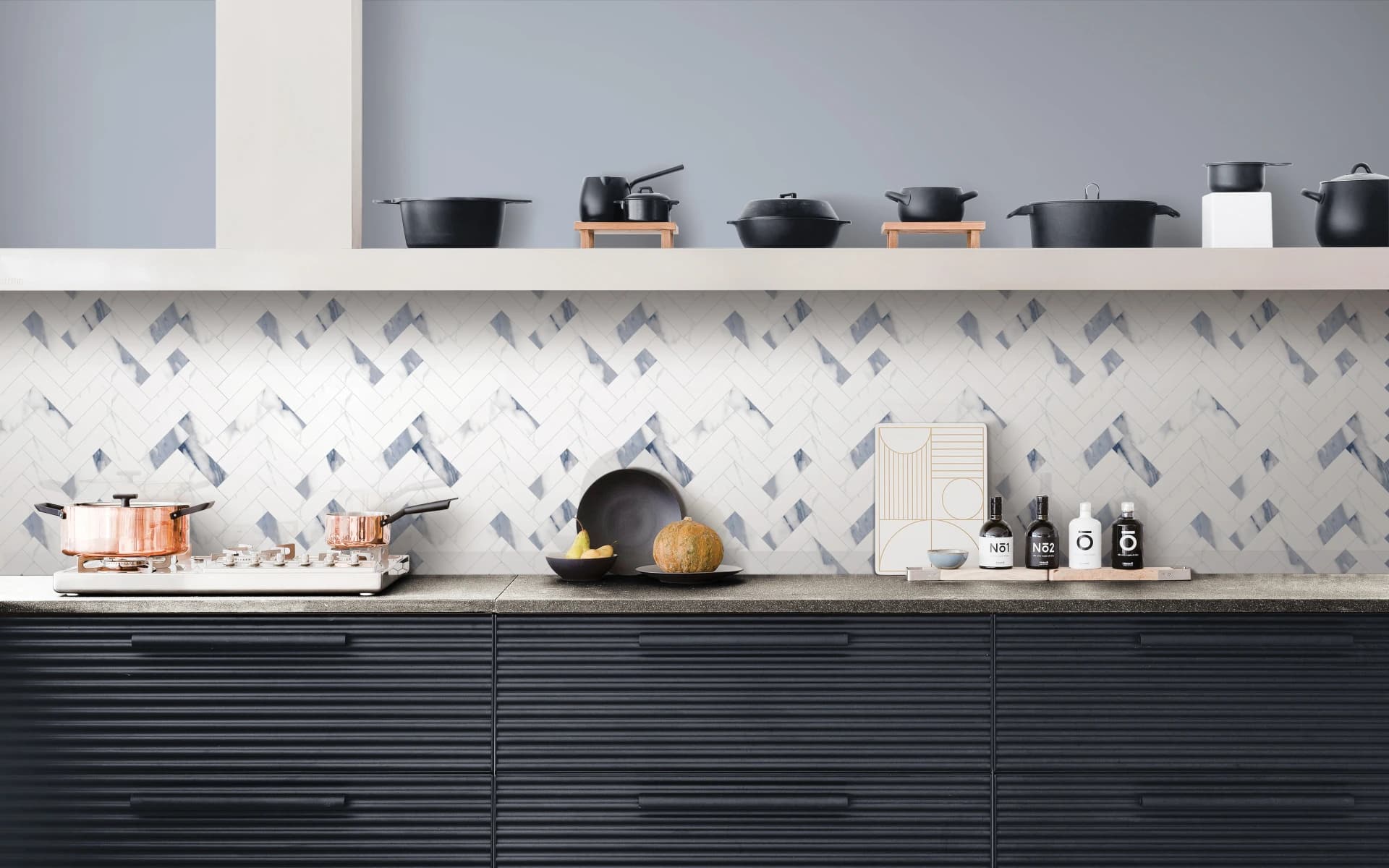
- Herringbone — possible with rectangular zellige, but ask your installer if they have done it before. Hand-cut zellige doesn't always cut clean.
Order 15-20% extra
Two reasons:
- Lay-out culling. A good installer pulls aside any tiles that read too dark, too cracked, or have edges that don't match the field. You'll lose 5-10% to culling alone.
- Wall fit. Walls are never perfectly square. With normal tile you cut to fit; with zellige, you'd rather have spare full tiles than awkward partial cuts that show.
We recommend 15% overage for a small backsplash, 20% for a full wall.
Install notes for your contractor
Three things to communicate explicitly:
- Back-butter every tile. Mesh-backed sheets aren't the norm — these are individual pieces, often laid with very thin (1-2mm) grout joints.
- No spacers. Or use 1mm spacers only as kickers — the joint comes from the irregular edges meeting each other.
- Sealer before grout. Zellige glaze is technically waterproof but porous around the edges. Sealing before grouting prevents grout haze from soaking into edge cracks.
A grout that's close to (but slightly lighter than) the tile color reads as more "monolithic" than a contrasting grout.
Living with it
Zellige is forgiving of daily cooking. Wipe spills with a soft cloth and a pH-neutral cleaner — no citric acid cleansers, no abrasives, no white-vinegar sprays. The mineral glaze is hardier than people expect; it's the unsealed edges that don't love acid.
Most kitchens we install don't need re-sealing for 5+ years. Just keep a tube of pH-neutral cleaner under the sink and you'll be set.
Want help specifying zellige for your project? We carry a wide working library of zellige from Fez at our Lomita studio. Visit by appointment and we'll prep samples in your colors before you arrive.